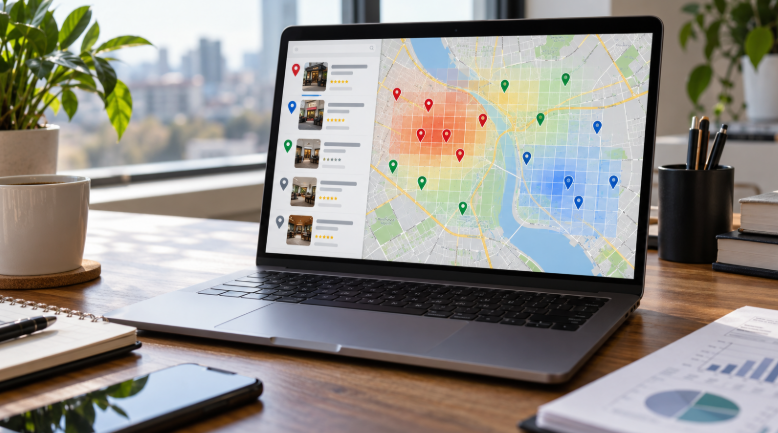
Your Google Maps ranking can change significantly depending on where the search happens. A business might appear in the top three results when someone searches from two miles away, drop several positions five miles away, and disappear from the first set of Maps results in another part of town. That doesn’t necessarily mean anything is wrong with your SEO. Location is part of how Google decides which local businesses to show.
This is one of the biggest differences between traditional organic rankings and local search. At True Social Marketing, we look at local visibility across the actual areas a business wants to reach instead of treating one manual search from one location as a complete picture of performance.
Why Does a Google Maps Ranking Change by Location?
Google wants local search results to make sense for the person making the search.
According to
Google’s own explanation of local ranking, local results are mainly based on relevance, distance, and prominence. Distance changes every time the searcher’s location changes.
Suppose you own an HVAC company in Sacramento. Someone searching for “AC repair” from a neighborhood close to your business may see your listing near the top of Maps. A person searching the same phrase from the opposite side of Sacramento might see a different group of companies.
Both searches are valid.
Google isn’t assigning your business one permanent Maps position for the entire city. It is evaluating which businesses make the most sense for that specific search.
Distance Is a Real Local Ranking Factor
Distance is the most obvious reason Google Maps rankings change geographically.
If someone searches without including a city or neighborhood in the query, Google uses what it knows about the person’s location. That gives searches such as “electrician,” “dentist near me,” or “landscaping company” a strong geographic component.
Even adding a city name doesn’t make proximity irrelevant.
A business located near the center of a city may have a different visibility pattern from a business near the edge of the same city. That matters even more in large or competitive markets where customers have many nearby options.
You generally can’t optimize your way into being physically closer to every person in your service area.
That doesn’t mean businesses should ignore areas farther from their location. It means expectations should reflect how local search actually works.
Your Google Maps Ranking Isn’t One Number
Business owners often search their main keyword, see where they rank, and use that position as their benchmark.
The problem is that a single search gives you a single observation.
If you search “plumber Sacramento” from your office and find yourself in position two, that doesn’t mean everyone in Sacramento sees you in position two. Another person could see you sixth. Someone several neighborhoods away may not see you in the first group of results at all.
The same problem works in reverse. Searching from one weak location could make your overall local SEO performance look worse than it really is.
A more useful question is: Where does the business have strong visibility, and where does that visibility start to weaken?
That geographic pattern gives you much better information than repeatedly checking one keyword from the same phone or computer.
Relevance Still Matters Alongside Distance
The closest company doesn’t automatically win.
Google also considers how closely a business matches what the person searched for. A company farther away may outrank a closer competitor when Google considers it a stronger match for the query.
Your Google Business Profile plays an important role here. Categories, services, business information, and other profile details give Google information about what the company actually does.
Your website adds further context.
If a contractor provides kitchen remodeling, bathroom remodeling, home additions, and whole-home renovations, useful pages addressing those individual services give search engines clearer information than a website that simply describes the company as a general contractor.
We cover the broader process on our
Local SEO service page, including local listings, content, technical SEO, citations, competitor research, and backlink work.
Prominence Affects How Far Your Visibility Travels
Two similar businesses located near each other may still have very different Maps visibility.
Google describes prominence as how well known a business is. Its local ranking guidance specifically references signals such as reviews, links, and the business’s broader presence online.
An established company with a strong website, legitimate backlinks, consistent business information, and a substantial review history may remain visible across a wider area than a newer competitor.
This is one reason local SEO shouldn’t focus exclusively on the Google Business Profile itself.
Your website, local citations, backlinks, reputation, and overall search presence contribute to the larger picture Google uses to understand the business.
Our
Google Business Profile optimization guide goes deeper into the profile-specific work that supports local visibility.
Why “Near Me” Searches Vary So Much
“Near me” searches make proximity especially obvious.
When someone types “roofing company near me,” they’re effectively asking Google to interpret where they are and return relevant nearby businesses.
Move the searcher several miles and the result set can change.
This is exactly what should happen. Someone in Roseville doesn’t necessarily need the same “near me” results as someone searching from downtown Sacramento.
Businesses with broad service areas sometimes find this frustrating because they may legitimately serve customers 20, 30, or 40 miles away. The service area a company is willing to travel to and the area where it ranks prominently in Maps aren’t necessarily identical.
Setting a large service area in your Google Business Profile doesn’t automatically make the business rank equally throughout that territory.
Does Searching Your Own Business Affect What You See?
Manual searches are useful for quick checks, but they shouldn’t become your entire ranking measurement system.
Search results can vary because of location, query wording, device context, and changes occurring in the local competitive environment. Google also changes results as businesses update profiles, receive reviews, publish content, gain links, or alter their own SEO strategies.
Repeatedly searching one phrase from your office gives you a narrow view.
It can also create unnecessary panic. A business owner might see a ranking move from second to fifth and assume something major happened, even though visibility across the rest of the market remains stable.
SEO reporting works better when you look for patterns over time.
How Should You Measure Local Rankings?
Start by tracking the searches that actually matter to your business.
A broad keyword with high search volume isn’t automatically the most useful keyword. Service-specific searches often reveal much more about whether you’re reaching potential customers.
Then evaluate visibility across the geographic area you actually serve.
For a Sacramento service business, that could mean checking performance across different parts of Sacramento and nearby communities rather than treating one downtown search as representative of the entire market.
You should also compare ranking data with other performance indicators.
Are more people discovering your Google Business Profile? Is organic traffic reaching important service pages? Are qualified calls and form submissions increasing?
Ranking reports become much more useful when they connect visibility with actual customer behavior.
What If You Rank Well Near Your Business but Poorly Everywhere Else?
Some decline with distance is normal.
A sharp decline close to the business deserves a closer look, especially if competitors remain visible across the same area.
Start with the fundamentals. Make sure your Google Business Profile accurately reflects the business, categories, services, hours, and other relevant information. Review the website to see whether it clearly supports the services and locations you want Google to associate with the company.
Then compare the business with the competitors that consistently appear above it.
They may have stronger reviews, more established websites, better service content, stronger backlinks, clearer local relevance, or a longer history in the market.
An
SEO audit is useful when the reason isn’t obvious because local ranking problems don’t always originate inside the Google Business Profile.
Should You Create Pages for Every City You Want to Rank In?
Location pages have a place in local SEO, but creating dozens of thin pages with nearly identical wording usually doesn’t give visitors much value.
A location page should exist because there is something meaningful to say about serving that market.
Businesses operating in several cities may benefit from well-developed location content that explains relevant services, local context, customer questions, and how the company works in that area.
Avoid treating city names like interchangeable keywords.
A useful page needs enough substance to deserve its own URL.
Can You Improve Your Google Maps Ranking Farther Away?
You can strengthen the signals Google uses to understand and evaluate your business, but no legitimate SEO strategy guarantees the same ranking across an entire region.
Improving local visibility often involves better profile information, stronger service content, useful location content where appropriate, legitimate reviews, citations, backlinks, technical website improvements, and ongoing competitor analysis.
The effect usually develops gradually.
As we explain in our article on
how long local SEO takes, businesses often start seeing meaningful movement within several months, but competition and the existing strength of the business affect the timeline.
Look at the Local Search Area, Not One Ranking
A changing Google Maps ranking is usually a feature of local search, not evidence that Google is randomly moving your business around.
Distance changes as the searcher moves. Relevance depends on the query. Prominence varies between competing businesses.
That creates a local visibility footprint rather than one universal ranking position.
At True Social Marketing, we evaluate
local SEO by looking at the larger search environment, the website, the Google Business Profile, competitors, and how visibility changes across the areas that matter to the business.
If your Maps rankings look strong from one location and disappear from another, the useful next step is to identify where that drop happens and what competitors are outperforming you there. That gives you something concrete to work on instead of trying to make sense of one ranking number.